How to choose a personalised gift: three questions
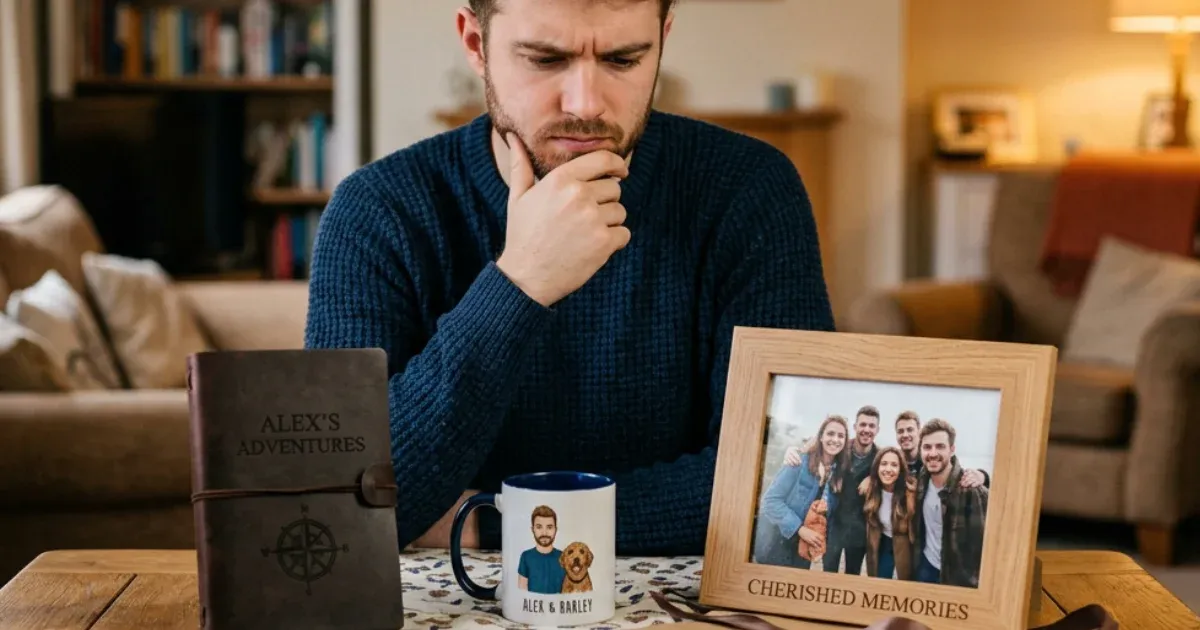
A personalised gift can be two very different things: an ordinary object with a name printed on it, or something that exists for one person only. The difference does not show in the price. It shows six months later, in whether it is still around the house or in a drawer.
The three questions below tell you which of the two you are about to order. Further down is the practical part: what takes personalisation well, how much time you actually need, and the mistakes that ruin a piece you have already paid for.
Who will look at it, and how often
A personalised gift gets seen twice. First by the person opening it, in front of everybody. Then every day, by whoever lives with it.
Those are two different tests, and the second one is harsher: a joke works once, an object has to survive habit. If you are choosing something that gets a laugh on opening but that nobody would keep on their bedside table, you are optimising the wrong five minutes.
How much it really says about them
This is where printing and personalisation part ways. A name on a mug says one thing, and says it to anyone who reads it. A detail only the two of you understand says far more, and says it to the people who matter.
The test is quick: list three things you know about that person that almost nobody else knows. A date that is not a birthday. A phrase they always repeat. A place you went to once. If the gift holds none of them, it is not personalised — it is engraved.
Do they like it, or do you
Made-to-measure gifts have a flaw that off-the-shelf ones do not: they cannot be exchanged. It is worth asking, before ordering, whether what you are choosing is something that person actually likes or something you find funny.
Often they are the same thing. When they are not, it shows immediately, and there is no return to put it right.
What takes personalisation well, and what does not
Personalisation works on objects that get used or looked at every day and that do not already have a strong identity of their own: a plain surface, a clear purpose, no bulky logo stealing the scene from your message.
Three categories take it badly. Clothing, because size is a gamble and a personalised garment in the wrong size cannot be swapped. Very fashionable objects, because personalisation freezes them in a particular year and ages them faster. And anything already covered in branding, where your line becomes the second thing anyone reads.
Rule of thumb: the quieter the object, the louder the personalisation.
How much time you actually need
A personalised gift cannot be ordered on the same timeline as an off-the-shelf one, because it is made after the order. Production time is added to shipping time, and around peak dates both get longer.
With us every doobli is made to order: production takes two to five working days, and shipping is added on top. Delivery times are shown at checkout and in your confirmation email, because they change with the destination.
If the occasion has a fixed date, two weeks is the smallest sensible margin. For December, order by the end of November: gift searches in Italy climb from early November and peak in the second week of December, which is also when couriers slow down.
The four mistakes that cost you the gift
Nearly every problem with a personalised piece starts before production rather than after, and two minutes of checking avoids them:
- The misspelled name. Niccolò and Nicolò are two different people. Copy the name from a message they sent you, not from memory.
- The wrong date. Check the year, not just the day. It is the most common mistake on anniversaries.
- The low-resolution photo. A screenshot taken from a chat looks sharp on a phone and stops being sharp once printed. Always start from the original file.
- Text that is too long. More characters mean smaller characters. One short line engraved large is worth more than an unreadable paragraph.
The preview before ordering exists for this: a personalised piece cannot be remade like a standard one, and two minutes of checking are worth more than any guarantee.
The occasions where it works best
Personalisation gives most when the occasion already has a story inside it: an anniversary, a wedding, a graduation, a birth. There the specific detail has something to hang on to.
It gives less on generic, obligatory occasions, where the risk is personalising an object nobody asked for. If no detail comes to mind to engrave, it is probably not the right occasion for a made-to-measure gift.
Frequently asked questions
Which personalised gift is appreciated most?
The one that holds a reference only two people understand: a private date, a recurring phrase, a shared place. The name alone is not enough, because it is public information and says nothing about the relationship.
Can a personalised gift be returned?
As a rule, no. In Italy the fourteen-day right of withdrawal does not apply to goods made to measure or clearly personalised (art. 59 of the Consumer Code), except for manufacturing defects or mistakes on our side. That is why it pays to check the preview carefully. The full conditions, including what we do in case of a defect, are in our terms and conditions.
How far in advance should I order?
At least two weeks before the date, because the piece is made after the order. For Christmas the margin goes up to three or four weeks: demand is concentrated entirely in the first half of December.
A personalised gift or a more expensive one?
It depends on what you want to last. An expensive gift says how much you spent, a personalised one says how much attention you paid. The second holds up better over time, but forgives mistakes in choosing far less.
What can be personalised beyond the name?
Dates, the coordinates of a place, a phrase, a drawing, someone’s handwriting, the shape of a sound wave. Anything only someone who was there can verify works better than anything just anybody could know.
If the three questions have a clear answer, the hard part is done: all that is left is choosing the object to put it on.